Monday, 21 March 2022

Coronavirus - two years on

 On Thursday, 24 March, it will be two years since the United Kingdom was placed under lockdown on account of the coronavirus pandemic. I vividly remember the sunsplashed but empty streets of Stornoway, a total absence of visitors and no cruiseliners - whereas in previous years, up to 40 liners would call through the summer. Having to wait in a queue outside Tesco for up to 45 minutes on one occasion, and having to take an hour to go through the store. I recall shuffling through Tesco, 7 feet apart from the previous and the next customer, having to write up the shopping list in exact sequence - because if I forgot to pick up the mayonnaise in aisle 4, and did not think about it until aisle 6, I'd have to ask a member of staff to please go and pick it up for me. Having to wait at aisle 12 to be called to a checkout. Hardly any shops open, public transport severely limited - but hardly any cases here in the Western Isles. The horror stories from the mainland, with up to 1500 deaths each day, and heartrending accounts of people dying by the dozen in carehomes - like the one in Portree, 50 miles south of Stornoway in Skye - without any loved ones to hold their hand in their final moments.

The year 2021 brought hope in the shape of vaccinations, and the restrictions gradually eased. Visitors started to return to the isles, mostly in motorhomes (much to the aggravation of many locals), but no cruiseliners. The deathtoll continued to rise, and currently stands at 150,000 across the UK. Although the numbers of deaths or severe cases of Covid have gone down substantially, thanks to the vaccinations, here in the isles, we have been hitting high numbers in recent days, up to 155 on one day last week. The demographics have shifted to children, with many new cases among primary school age pupils. 

The war in Ukraine, with a potential for becoming a world-war conflagration, has eclipsed coronavirus from the headlines. The pandemic has not gone away, and a new round of vaccinations is starting across the country. In Scotland, we are still required to wear facemasks in an indoor, public setting. 

I started 2020 with trepidation. This, the third decade of the 21st century, is fulfilling that promise of being a period of concern, and I'll go so far as to say - we ain't seen nothing yet.

Thursday, 3 March 2022

Putin - isolated

I'm looking past the images of destruction, atrocities, suffering, displacement and horror. I see the man, who started a war - although his people are not allowed to call it that - on spurious grounds. Vladimir Putin (69), president of Russia. He is used to deploying tactics of "let's see what I can get away with". Forgetting that starting a war is ruled by the Laws of Unintended Consequences, the enterprise has blown up in his face in a breathtaking fashion. He will probably end up achieving his goals militarily. But at what cost. The human cost will be beyond imagination. However, my point is more the political and economic cost. Apart from half a dozen crackpot dictatorships, such as North Korea, Syria, Venezuela, Myanmar and the like, no nation on this earth overtly supports him. That leaves a very lonely, isolated man, perhaps cut off from reality. A very dangerous situation, also because he commands thousands of nuclear warheads. Unlikely to be used, but still. He has, after 8 days of fighting, not abandoned his vision for Europe, as being his fiefdom, his backyard. Cut off from NATO and the Americans, and the Russian Empire restored to its glory, as existed until 1989. And Ukraine coalesced into Russia. 

Putin is isolated, and has been since the pandemic kicked off two years ago. He will be surrounded by Yes Men, and his security apparatus is busy suppressing dissent. But this is 2022, not 1939. His economy is being asphyxiated, his sports men and women are now pariahs, and shipping and aircraft are not welcome anywhere anymore. 

How will this end? That is a question that those in power and authority around the world should be contemplating. Preferably by negotiation. But with a dogmatic individual like Vladimir Vladimirovich, that will be well-nigh impossible. He, like most Russians, does not like being compared to Hitler. Putin claims to be denazifying Ukraine - not realising he is behaving the way Hitler did between 1933 and 1945.  The parallels are disconcerting.

  • Georgia 2008 - the Rhineland in 1936.
  • Crimea 2014 - the Anschluß of Austria with Germany in March 1938 .
  • Donetsk and Luhansk 2014 - the Sudetenland, spring 1939.
  • Ukraine 2022 - Poland, September 1939. 

But that is where the parallels end abruptly. Poland was a walkover in 1939. Ukraine is resisting valiantly and the Russian campaign is lagging well behind schedule. Worse than that, from Putin's perspective, the world has rallied behind Ukraine within days, and he is left completely isolated. I will not look into the future, because wars are notoriously unpredictable. Hitler committed suicide on 30 April 1945, ten days after his 56th birthday. Putin will have his 70th birthday on October 7th. I wonder if there will be anything to celebrate for him by then.

Friday, 25 February 2022

Historical mistakes repeated

Today, Russian forces invaded Ukraine. The outcome for that country is likely to be subjugation if not annexation. Putin, like Hitler 83 years ago, felt resentment over the outcome of a previous conflict. In this case, the Cold War. 
By 1991, the West was crowing victory. The USSR had disintegrated, with Russia losing territory, power and its sphere of influence. Following years of upheaval, Putin came to power in 2000, and set about rebuilding his country. His armed forces were modernised, and through the supply of gas, oil and many other commodities not to mention money laundering through oligarchs and London's financial institutions, was able to build up a formidable war chest. The writing was on the wall by 2008, with an incursion into Abchasia, then a region in Georgia. Even more so in 2014, with the annexation of the Crimea. Putin's always trying to see what he would get away with. He was let off too lightly. 
Russia has not changed since the Czars, not since Communism. Paranoid and mistrustful, resentful against perceived or real wrongs, the West did not recognise the warning signs. Like Chamberlain in 1938, they felt that war could be averted through negotiation, read appeasement. A sign of weakness in Putin's eye. However, when former Warsaw pact countries in eastern Europe turned their backs on Russia and joined the EU, as well as NATO, Russia felt threatened. It's reaction when Ukraine expressed a desire to join those blocks was telling. It was a strategic mistake from Western blocks, not to realise or anticipate Putin's reaction. As outlined above, the first warnings appeared as far back as 2008. Ukraine and Europe will pay the price. Let's hope the conflagration remains relatively restricted in scope. 

Monday, 21 February 2022

Germany and Russia - 20th and 21st century

At the end of the First World War, in June 1919, a peace treaty was signed between the warring parties. It became known as the Treaty of Versailles. The treaty imposed punitive measures against Germany, firmly laying the blame for the conflict with the country, although if blame be apportioned, all were equally culpable. 

Germany lost territory and felt humiliated. In the 1920s, the country suffered an economic meltdown, with inflation skyrocketing - at one point, the US dollar was worth 1 million million Mark. Then, over the following 16 years, Adolf Hitler gradually rose to power, promising to make Germany great again. He retook the Saarland and Rhineland areas, which had been taken from Germany. Nobody opposed this aggression. In March 1938, he annexed Austria - with nobody opposing. In September 1938, with mounting concerns over war, the British Prime Minister Neville Chamberlain flew to Munich for talks with Hitler. At the time, the slaughter of World War 1 were still fresh in people's memories, and all thought was to avert another bloody conflict. Hitler reassured Chamberlain, and Neville's famous quote "Peace for our time" was to become the slogan for appeasement. In the early spring of 1939, Germany annexed the Sudetenland area of Czechoslovkia, and occupied the remainder of that country. In September 1939, Nazi Germany invaded Poland, which heralded six years of war. 

Fast forward 50 years. In 1991, the Soviet Union disintegrated, the Warsaw Pact of countries also under communist rule collapsed. These included Bulgaria, Romania, Czechoslovakia, East Germany, Hungary and Poland. Russia lost its empire of satellite states that used to be part of the Soviet Union. Think of Lithuania, Latvia and Estonia. Georgia, Belorussia, Uzbekistan, Armenia, Azerbaijan, Kazakhstan, Kyrgyzstan, Moldova, Turkmenistan, Tajikistan. And -

Ukraine. 

Then, along came a former KGB officer, Vladimir Putin. Born in 1952, Mr Putin served in the former German Democratic Republic until that state collapsed in 1990. Vladimir has been prime minister and president of the Russian Federation for more than twenty years. He has enjoyed popularity at the polls, on a ticket of making Russia great again. In fact, it is suggested that he would like to restore the old empire of the Soviet Union. Moves to that effect were seen with an incursion into Georgia in 2008, and the annexation of the Crimean peninsula, part of Ukraine, in 2014. The insurrection in eastern Ukraine, which started in the same year, has been on-going to date. It has led to the establishment of two break-away states around Donetsk and Luhansk. And since the start of 2022, Russia has built up a huge array of its armed forces around Ukraine. To date, 21 February, the tally stands at 190,000. Some of these are positioned in Belarus, ruled by Putin's henchman Alexander Lukashenko. Although frantic talks continue to date to avert war, signs are ominous that the pretext for an invasion of Ukraine is already being created. Is the diplomacy another attempt at appeasement, to achieve peace for our time? As I type this, news comes through that Russia has accused Ukraine of invading its territory and killed three troops - a claim hotly denied by Kyiv. A possible pretext for an attack.

We saw what happened when Adolf Hitler promised to make Germany great again in the 1930s. I do not expect Vladimir Putin to like being compared to Adolf Hitler. Russia suffered greatly through Nazi Germany's invasion of its territory between 1941 and 1944. It lost 20 million of its popultion as a result. But an invasion of Ukraine could lead to a European conflagration which could have an equally devastating consequence. 

Just became Putin wants to make Russia great again.

Saturday, 12 February 2022

Not ferry good

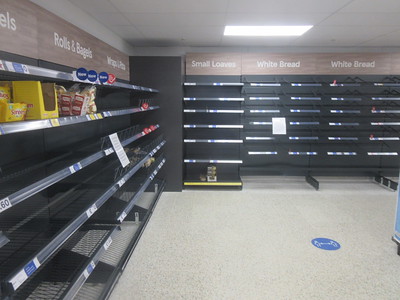
This winter has turned into a very windy if not stormy affair. A fortnight ago, we suffered gusts in excess of 90 mph, which caused some damage. 'Ordinary' gales have punctuated the time since, churning up the seas between the island and the mainland and leading to frequent cancellations of the ferry service. This week saw nearly three days without a ferry, leading to scenes like this in the supermarket. 


On other routes, the vessels concerned have suffered technical breakdowns or were away for their annual refit. 

The breakdowns can sometimes be traced back to the age of the boat; I think the eldest ship is 34 years old. You'd think that these would be replaced as time goes on, but no such plans appear to exist. Worse than that, two ferries that should have been in service 4 years ago are still in the shipyard, being built. Problems of a political, business or technical nature have led to that. 

In the coming week, a major storm is pencilled in for Wednesday. The forecast has only just about moved within the 5-day timeframe for reliability, so we'll see if the 90+ mph gusts materialise. Hopefully, they don't. 

Thursday, 27 January 2022

Holocaust Memorial Day 2022


Today it is 77 years ago since the infamous Auschwitz-Birkenau concentration camp was liberated by Soviet forces. More than a million people, mainly Jews, were killed there during the Second World War. The process was conducted as an industrial process. To date, some of the goods left behind by the victims of the Holocaust remain on display. These include suitcases with name tags, spectacle frames, hair and shoes. I have never visited Auschwitz and am not likely to.

January 27th is Holocaust Memorial Day, remembering all the victims of the Nazi's policy of extermination of all those they considered to be sub-human.

Holocaust Memorial Day remembers all victims of genocide.

We must never forget.

Tuesday, 25 January 2022

Burns Night 2022

It's Burns Night in Scotland, and it's haggis and whisky galore. Tortured renditions of Burns prose and poetry will be the order of the night, made even more tortured by the water of life. Haggis is an offal-based meat dish, and various bits and pieces of a sheep's innards are turned into basically mutton mince, packed into a sheep's stomach. This is served with neeps (turnips). I've tasted it once, and it's not far off mincemeat; but knowing how it's made it is not something I'd care to repeat in a hurry. Our local supermarket has shelves, laden with haggis. Leaving my slight sarcasm to one side, I would like to state that Robert Burns did not just write in Scots, he also wrote in perfect English.

Is there for honest Poverty
That hings his head, an' a' that;
The coward slave-we pass him by,
We dare be poor for a' that!
For a' that, an' a' that.
Our toils obscure an' a' that,
The rank is but the guinea's stamp,
The Man's the gowd for a' that.

What though on hamely fare we dine,
Wear hoddin grey, an' a that;
Gie fools their silks, and knaves their wine;
A Man's a Man for a' that:
For a' that, and a' that,
Their tinsel show, an' a' that;
The honest man, tho' e'er sae poor,
Is king o' men for a' that.

Ye see yon birkie, ca'd a lord,
Wha struts, an' stares, an' a' that;
Tho' hundreds worship at his word,
He's but a coof for a' that:
For a' that, an' a' that,
His ribband, star, an' a' that:
The man o' independent mind
He looks an' laughs at a' that.

A prince can mak a belted knight,
A marquis, duke, an' a' that;
But an honest man's abon his might,
Gude faith, he maunna fa' that!
For a' that, an' a' that,
Their dignities an' a' that;
The pith o' sense, an' pride o' worth,
Are higher rank than a' that.

Then let us pray that come it may,
(As come it will for a' that,)
That Sense and Worth, o'er a' the earth,
Shall bear the gree, an' a' that.
For a' that, an' a' that,
It's coming yet for a' that,
That Man to Man, the world o'er,
Shall brothers be for a' that.