The war in Ukraine is moving towards its 4th anniversary next February. In 2022, the Russian Federation invaded the territory of its western neighbour, having already occupied the Crimea and areas of the provinces of Luhansk and Donetsk since 2014 through proxies. Ukraine is resisting valiantly, but is inexorably, slowly losing terrain and men. As Russia invaded without provocation, any ceasefire that includes ceding territory to Russia by Ukraine would be unfair. However, that is exactly what Donald "Chamberlain" Trump is proposing. Let's not forget what preceded this war.
Russia's president, Vladimir Putin, assisted a secessionist movement in Abchazia, a rebellious province of Georgia (on the east coast of the Black Sea) in splitting off from Georgia. Apart from loud protests back in August 2008, no military consequences ensued. Putin occupied the Crimea, part of Ukraine, in March 2014, without any military consequences. Putin's forces allegedly shot down a civilian airliner over the east of Ukraine in July 2014, with the loss of 300 lives - without any retalitatory action. Putin ordered a full-scale invasion of Ukraine in February 2022. This time round, Ukraine's allies rallied round with supplies of military hardware and intelligence. When Donald Trump became US president in January, he started off by giving Ukraine's president Volodymyr Zhelensky a row in the White House. Trump likes strongmen, like North Korea's Kim Jong Un and Russia's Putin. And Putin manipulates Trump.
We saw in the 1930s what happens when you try to pacify aggressors. "Peace for our time", Neville Chamberlain said in November 1938, upon adorning a piece of paper with some more ink in Munich. Adolf Hitler did not pay the slightest attention, but invaded Czechoslovakia the next year, followed by Poland in September 1939. Only then did we have a declaration of war from Britain and France. Had these allies stood up to Hitler upon his incursions into the Rhineland in 1936, for instance, war might have been averted. But we'll never know.
We'll see what happens if Trump's peacedeal is adopted.


 After
the unspeakable atrocities of the Second World War, Germany was divided
into four by the victorious allies. The British, French and American
sectors became West Germany, whilst the Soviet sector was turned into
East Germany, a communist state. Berlin was similarly divided. Until
1961, people from the East fled to the West in droves. A barrier was
erected across Berlin in August 1961, later replaced by a high, concrete
wall. Similar barriers were put up along the borders between East and
West Germany. Anyone trying to flee from East to West was shot on sight,
no questions asked. The advent of Mikhail Gorbatchov as leader of the
USSR in the 1980s heralded a start of change. And when this wind of
change blew across eastern Europe, it blew away all the communist
regimes within the space of a few months in 1989.
After
the unspeakable atrocities of the Second World War, Germany was divided
into four by the victorious allies. The British, French and American
sectors became West Germany, whilst the Soviet sector was turned into
East Germany, a communist state. Berlin was similarly divided. Until
1961, people from the East fled to the West in droves. A barrier was
erected across Berlin in August 1961, later replaced by a high, concrete
wall. Similar barriers were put up along the borders between East and
West Germany. Anyone trying to flee from East to West was shot on sight,
no questions asked. The advent of Mikhail Gorbatchov as leader of the
USSR in the 1980s heralded a start of change. And when this wind of
change blew across eastern Europe, it blew away all the communist
regimes within the space of a few months in 1989. 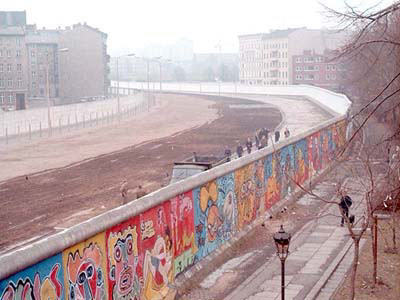 The
Berlin Wall was torn down on 9 November 1989, and you can see the
dilemma. Do we remember the Kristallnacht, and not celebrate the
reunification of Germany? Do we celebrate the reunification, and ignore
the Night of Broken Glass? Maybe the two can be reconciled. The
Berliners remember the Kristallnacht in a very low-key but poignant
manner. Every year, in the evening of November 9th, candles are left on
the doorsteps of houses that were ransacked that night.
The
Berlin Wall was torn down on 9 November 1989, and you can see the
dilemma. Do we remember the Kristallnacht, and not celebrate the
reunification of Germany? Do we celebrate the reunification, and ignore
the Night of Broken Glass? Maybe the two can be reconciled. The
Berliners remember the Kristallnacht in a very low-key but poignant
manner. Every year, in the evening of November 9th, candles are left on
the doorsteps of houses that were ransacked that night. 


